
Start with usage
Identify operational value and distinguish detection from recognition.
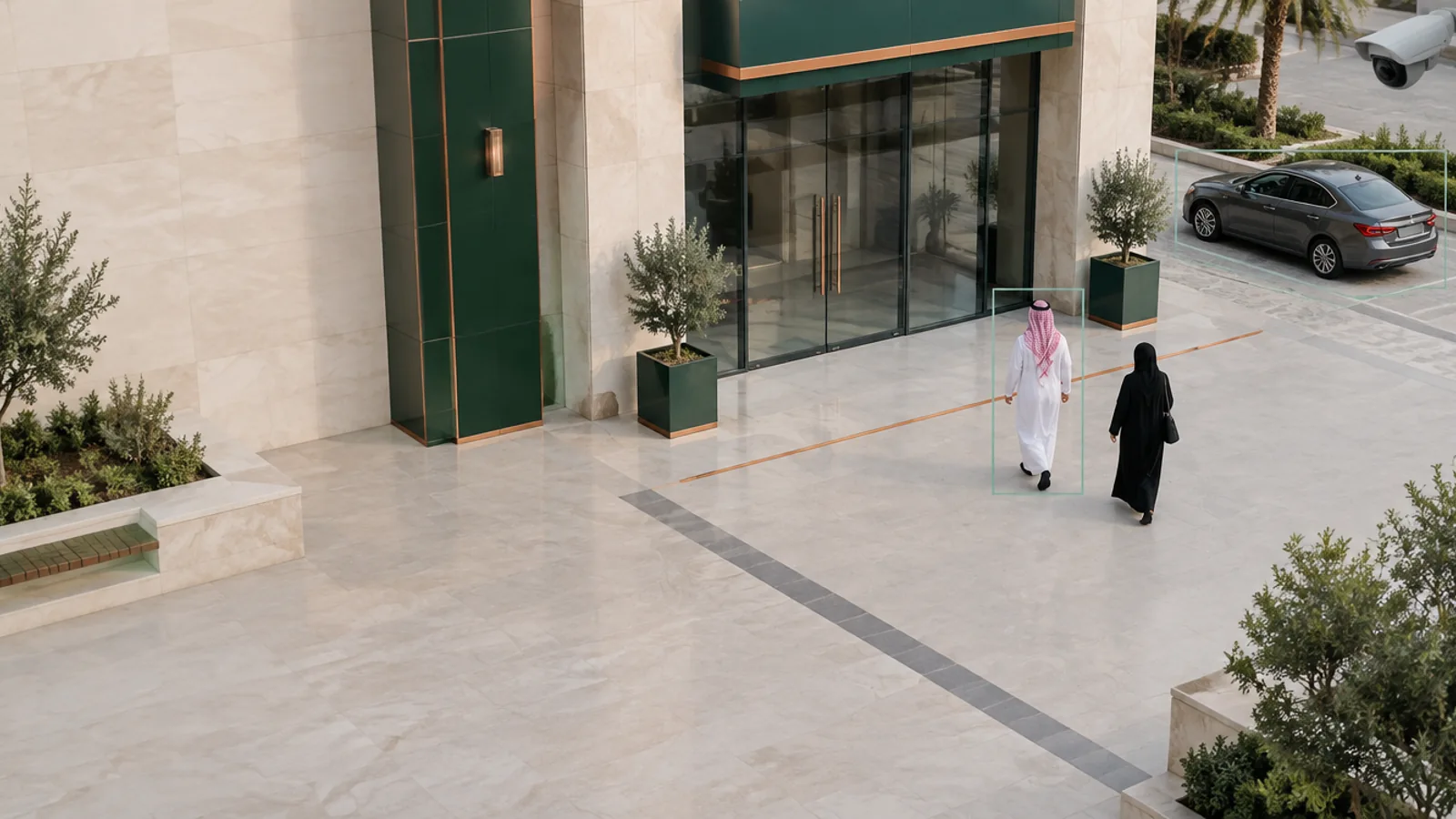
We integrate face recognition, people counting, intrusion detection and license plate recognition with compatible CCTV, according to operational needs, cameras and analytics platform capabilities.
Hours of video need reviewing to find an important event.
Events are noticed late, or there are more screens than the team can watch.
Repeated searches for a person or vehicle in recordings.
No clear view of entry and exit numbers or area occupancy.
Restricted areas need defined entry and crossing rules.
Existing cameras are used mainly for viewing and recording.
CCTV provides viewing and recording. Intelligent video analytics adds detection of selected events and objects through supported rules; it does not understand everything in a scene.
Detects a face in an image and may generate a face-based event where supported. It does not identify the person.
Attempts facial matching against registered identities or data authorized for use, according to platform capabilities and imaging conditions. This is distinct from detecting a face.
Detect faces and their presence in a scene without establishing identity.
Match faces against registered identities and data where the platform supports it.
Count people and entry or exit movements at defined points.
Review area occupancy, visitor flow and capacity where supported.
Detect crossing of a virtual line, potentially including direction.
Detect entry to restricted areas according to defined boundaries and rules.
Detect extended presence in an area based on a project-defined rule.
Detect people, vehicles and selected object classes supported by the system.
Detect and count vehicles, directions and entry or exit events.
Read and search license plates within suitable imaging and system conditions.
Review crowds, density and congestion, with high-occupancy alerts where supported.
Search recordings using supported people, vehicle, object and event attributes.
Connect selected events to a monitoring interface or supported notifications.
A site and surveillance survey helps define capabilities, imaging and a suitable platform.
Numerous cameras or searches for a person, vehicle or event that currently require manual video review.
Stores, commercial centers, offices and facilities that need visitor counts, flow analysis or occupancy monitoring.
Warehouses, complexes and buildings with several entrances needing intrusion, line crossing or supported identity matching.
Parking or a gate requiring LPR, or an existing system assessed for events, alerts and intelligent surveillance.
Open a group for details. Each function is assessed against cameras, VMS, platform, imaging and required licenses. All capabilities are not automatically available in every system.
Face presence, people counts and identity matching serve different needs and imaging conditions.
Define lines, zones and time-based rules for the selected events within the scene.
Vehicle presence and plate recognition are different functions with different imaging and analytics needs.
Integration and notification channels depend on the selected systems, without an absolute instant-alert promise.
Processing, compatibility and data management form part of the design from the start.
Camera numbers and capabilities, analytics type, networks, processing requirements and the project determine where analysis runs.
Part of the analysis runs on the camera or a nearby device where hardware supports the required functions.
A server or central platform analyzes video according to processing capacity and camera and video management compatibility.
The design may combine methods to distribute processing and functions according to project needs.
We review camera model, resolution, processing, VMS, platform, placement, lighting, networks and the required analytics. Parts of the current infrastructure may be suitable.
Review image, connectivity, software and camera compatibility with the required function before defining upgrades.
A software or VMS upgrade, analytics server, AI camera or selected camera replacement and repositioning may be needed.
Software is one part of the solution. Camera position, angle, resolution, lighting, distance, field of view, scene conditions and processing platform affect usable functions.
Facial matching or plate recognition needs suitable imaging conditions beyond detecting that a person or vehicle is present.
Review scenarios in the actual scene and adjust zones, rules and settings within available capabilities.
Plate recognition requires suitable cameras, angles, lighting and a compatible platform. Entrance movements and imaging are defined before assessing recognition, search and gate integration.
Automatic plate recognition, plate search and vehicle entry/exit logging where supported.
The system may integrate allowlists/blocklists, parking and gates according to compatibility and project design.
Connect analytics results to cameras, recording, VMS, analytics servers and event management according to compatibility so data can support monitoring and search.
VMS may support person, vehicle, object and event search, timeline filtering and playback of relevant clips.
Connect events to monitoring interfaces, notifications and supported actions, including selected access and gate scenarios.
Data such as facial matching requires careful management. Define access, storage, retention and supported auditability with the customer according to their policies and applicable requirements.
User permissions and authorized access to data, search and matching according to roles.
Define storage, retention and usage traceability where supported by the platform according to project needs.
What event or information does the business need to detect?
Assess existing cameras, VMS, networks and coverage.
Identify what can be used and what needs upgrading.
Define rules, zones, functions and platform.
Prepare cameras, analytics and supported integrations.
Review responses to required cases within actual capabilities.
The Raseila approach
Identify operational value and distinguish detection from recognition.
Assess cameras, management and compatibility before proposing replacement.
Cameras, VMS, networks and analytics form one design.
Consider imaging positions and the environment, then review scenarios on site.
Detection finds a face without establishing identity. Recognition attempts matching against registered identities or data authorized for use where the platform supports it.
Potentially, depending on model, resolution, processing, platform, VMS, networks and imaging. Compatibility and upgrades are assessed before proposing component replacement.
It depends on the system, intended function and image conditions. Camera, angle, lighting, resolution, distance and matching platform compatibility are assessed; every camera cannot be assumed suitable.
Yes, where supported. Entry/exit counts, occupancy and visitor flow may be included according to planning, imaging and platform capabilities.
Virtual zones, lines and entry or crossing rules can be configured where supported, then scenarios tested in the actual scene.
LPR/ANPR can be assessed around cameras, platform and imaging. Suitable angles, lighting and equipment are required, with search, logs and gate integration where supported.
Some systems support person, vehicle, object and event search and timeline filtering. VMS, analytics platform and the data produced by the system determine the available functions.
Next step
Start with a survey of surveillance infrastructure and business needs to define suitable detection, search and monitoring capabilities.