
Assess and design the architecture
Review sources, screens, zones and existing distribution, then select IPTV, MATV/SMATV or a suitable combination.
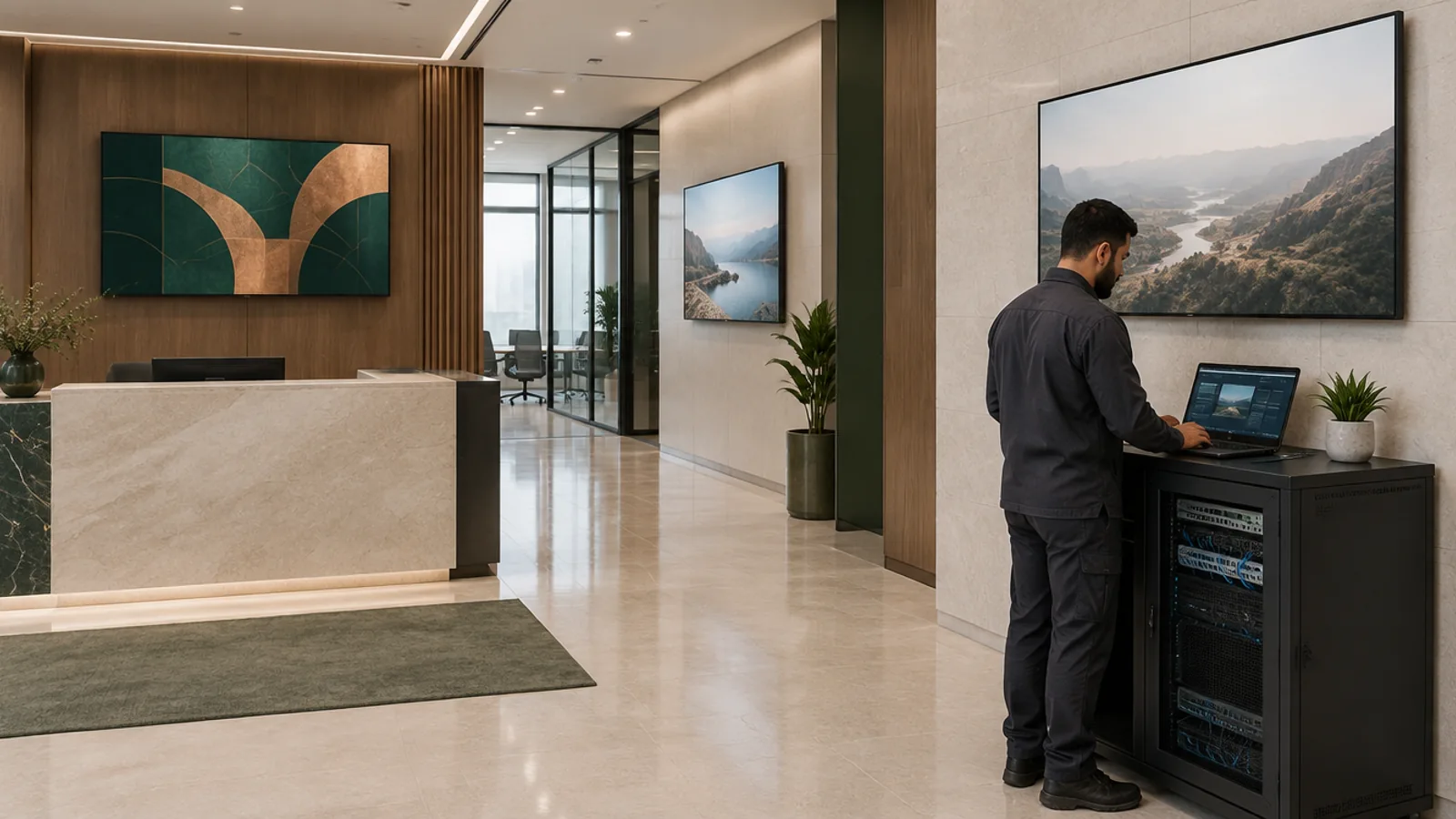
We design and install IPTV, MATV/SMATV and digital signage, connecting smart displays, sources and networks in a manageable distribution system with room to grow.
Each screen is managed separately and updating several displays is difficult.
Multiple receivers and an older, disorganized channel system or headend.
Signal or distribution quality differs across floors and areas.
Adding screens or zones requires complex cabling and connectivity changes.
The same content cannot easily reach everyone, or different departments need different content.
Smart TV, casting or IPTV connections are problematic, or MATV/SMATV needs upgrading.
Here, IPTV means television and visual content delivered through an IP network designed for the premises. Sources, transport, management and receiving screens are planned together.
The system receives available channels or sources, processes them and prepares them for centralized distribution according to design.
Switching, VLANs, backbone connections and bandwidth are planned around displays, content and the distribution method.
Servers, middleware and channel or content management may be needed according to solution requirements and compatibility.
Compatible TVs, set-top boxes or media players are connected and their settings and connectivity reviewed.
Review sources, screens, zones and existing distribution, then select IPTV, MATV/SMATV or a suitable combination.
Prepare channel and source reception, processing and distribution, with satellite or master antenna infrastructure integration where required.
Plan and configure IPTV infrastructure and connect smart TVs and endpoints according to bandwidth, segmentation and compatibility.
Configure device-to-screen casting and interactive interfaces or applications where supported by selected systems.
Connect displays, players and content management for information, menus, promotions and audio/video across zones and supported schedules.
Assess legacy upgrades or IP migration, test signals, content and connectivity, and provide maintenance and expansion within scope.
A survey of displays, sources and existing infrastructure defines suitable distribution and upgrades.
Equip commercial buildings, offices, complexes or facilities, or distribute channels and content across many displays.
Upgrade MATV, SMATV or headend, address uneven signals or assess migration from traditional distribution to IP.
Digital signage for reception, wayfinding, restaurant and café menus, internal messages and promotions.
Connect smart TVs, add casting or extend to more screens, floors and zones within a compatible design.
Open a group for details. We provide technical distribution and integration for content the customer has the right to use or distribute. Functions depend on solution capabilities and compatibility.
Bring sources together and prepare signals for site-appropriate distribution.
Professional distribution over a network planned for content and displays.
The network forms part of the distribution design beyond basic screen connectivity.
Display functions selected according to the system and technical compatibility.
Connect management to displays, zones and content updates.
Distribution built around the actual use of each area.
Assess what can be retained and developed before defining replacement or migration.
Infrastructure, display numbers, content, interaction, expansion, networks and management guide the choice. IPTV is not automatically the best fit for every project.
Centralized distribution of terrestrial or available TV signals through master antenna and suitable cabling infrastructure.
Centralized satellite channel distribution to multiple points, with signal reception and processing.
Television and media delivered over an IP network with compatible screens, endpoints and management.
Display numbers, content and transport methods define network requirements. We review the path from source to endpoint, beyond the connection to the TV.
Plan switches, VLANs, bandwidth, backbone, cabling and fiber where required, with suitable endpoint connectivity.
Some systems distribute streams to groups of screens through multicast. Suitable IGMP settings help direct streams to requesting endpoints according to design.
Displays, platforms and functions are assessed for compatibility. Network connectivity alone does not establish support for every distribution or casting method.
Connect displays to suitable networks, applications and management, or use a compatible receiving endpoint where needed.
Casting brings content from a user device to a screen in a supported scenario. Central content reaches selected displays through the distribution and management system.
Digital signage forms part of the media system for reception, wayfinding, menus, promotions, schedules and internal communications.
Compatible CMS and media players can manage playlists, screen groups and display schedules where supported.
Reception information, menus in a service area or a campaign across displays, with suitable content and scheduling for each group.
Multi-zone distribution can deliver the same content everywhere or different content by location according to system components.
Site information, messages or promotions through centrally managed content or appropriate playlists.
Channels or content for each area or department, with internal display connectivity and floor expansion according to design.
Identify screens, zones, channels and content.
Assess the existing system, network, cabling and headend.
Choose IPTV, MATV, SMATV or a suitable combination.
Deploy headend, networks, displays and components.
Review channels, content, distribution and connectivity.
Add displays, zones or functions according to needs and scope.
The Raseila approach
Start with content type, viewing and management before choosing distribution architecture.
Assess what can be retained before defining an upgrade or replacement.
Consider headend, networks and screens together with future zones and endpoints.
Review content distribution and connectivity on the actual site infrastructure.
IPTV delivers content over an IP network. MATV centrally distributes terrestrial or available TV signals, while SMATV distributes satellite channels centrally. Sources, infrastructure, displays and required functions guide selection.
It depends on design. The existing network may support suitable VLAN segmentation, bandwidth and video distribution settings, or dedicated infrastructure may be required.
Potentially, according to display, application and endpoint compatibility. We assess existing equipment before defining additions or upgrades.
Yes, where supported. Groups, zones, channels and playlists can be organized around departments, locations and management needs.
Headend, cabling or endpoint upgrades and additional displays may be possible, or a phased IP migration according to condition and compatibility. A survey defines the scope.
Yes, according to project needs and compatibility. Work can include displays, content management and players, or device-to-screen casting through supported technology.
Raseila provides technical infrastructure, distribution systems and integration. Channel sources and content rights depend on subscriptions or licenses the customer has the right to use or distribute.
Next step
Survey sources, displays, networks and the current setup to define suitable distribution, management and upgrades.